Slipped and Fell at a Missouri Store? Here's What the Property Owner Owes You
If you slipped and fell at a grocery store, restaurant, or apartment complex in Missouri, the property owner may owe you compensation. Here is what Missouri law says about their duty to keep you safe — and what you must prove to hold them to it.
By Joseph Ott
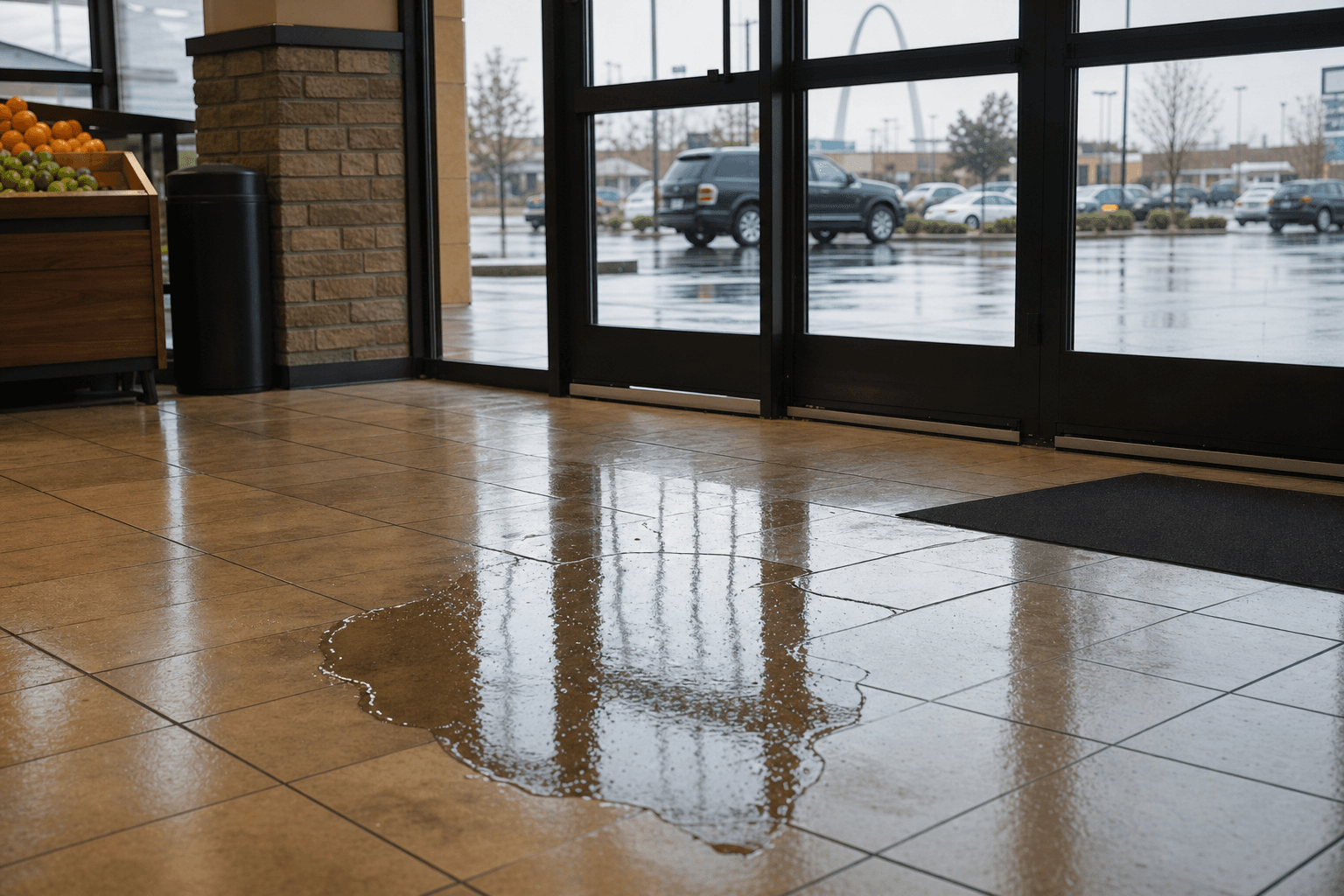
Your foot hit something slick in the produce aisle, and you were on the ground before you could react. Your back slammed the floor. Your wrist bent the wrong way. No wet floor sign. No cone. No employee in sight.
Within days, the store's insurance company will call with a familiar script: you should have watched where you were going.
Missouri law disagrees more often than you might think. Property owners owe their customers a real duty of care. When they break that duty and you get hurt, they owe you compensation. But winning requires proof — and the proof starts disappearing within hours of your fall.
Missouri Law Makes Property Owners Answer for Unsafe Conditions
When you enter a store, restaurant, or any business as a customer, Missouri law calls you an invitee. You are there for the owner's benefit. So the law gives you its strongest protection.
An owner who invites the public in must do three things: inspect the property for hazards with reasonable frequency, fix dangerous conditions within a reasonable time, and warn visitors about hazards that cannot be fixed right away. Missouri courts applied this framework in Cox v. J.C. Penney Co., 741 S.W.2d 28 (Mo. banc 1987), and juries still receive it today through the Missouri Approved Instructions, MAI 22.03.
At trial, your case stands on four legs:
- The property had a condition that posed an unreasonable risk of harm.
- The owner knew about the condition, or ordinary care would have revealed it.
- The owner failed to use ordinary care to remove it, barricade it, or warn of it.
- That failure directly caused your injury.
Knock out any leg and the claim falls. The leg that breaks most often is the second one: notice.
What You Must Prove: Notice Wins or Loses the Case
A store is not an insurer of your safety. Missouri holds the owner responsible only when the owner had a fair chance to find and fix the hazard. That fair chance has two forms.
Actual notice means someone in charge knew. An employee saw the spill. A customer reported the broken step. A maintenance ticket sat in the system for a week. Prior complaints about the same spot are gold.
Constructive notice means the hazard sat there long enough, and openly enough, that a careful owner would have found it. The Missouri Supreme Court adopted this standard generations ago in Burrell v. Mayfair-Lennox Hotels, Inc., 442 S.W.2d 47 (Mo. 1969), and it still decides cases today.
How do you prove time? Through circumstantial evidence. A grape smeared and tracked by shopping carts did not hit the floor seconds before you did. A puddle with cart tracks through it, dirt at the edges, or footprints fanning out tells the same story. So do the store's own records: sweep logs, inspection schedules, and surveillance video show whether the store checked its floors every fifteen minutes or never checked them at all.
One caution. Some states relax the notice requirement for self-service stores under a "mode of operation" theory — the idea that a store inviting customers to handle merchandise must expect spills. Missouri appellate courts have not squarely adopted that shortcut. Build your Missouri case on notice evidence, not on the hope that a court will skip the requirement.
"You Should Have Seen It" Rarely Ends a Missouri Claim
The insurer's favorite argument is that the hazard was open and obvious, so the fall is your fault. Missouri gutted that argument decades ago.
Missouri adopted pure comparative fault in Gustafson v. Benda, 661 S.W.2d 11 (Mo. banc 1983), and wrote it into statute at RSMo 537.765. Your own carelessness no longer destroys your claim. It shrinks your recovery by your percentage of fault. A jury that puts 20 percent of the blame on you and 80 percent on the store awards you 80 percent of your damages.
The open-and-obvious doctrine changed with it. In Harris v. Niehaus, 857 S.W.2d 222 (Mo. banc 1993), the Missouri Supreme Court held that whether a danger was obvious matters mainly to how fault gets divided — not to whether the owner owed a duty at all. And in Patton v. May Department Stores Co., 762 S.W.2d 38 (Mo. banc 1988), the court recognized that an owner can remain liable even for an obvious danger when the owner should expect visitors to be distracted or to encounter the hazard anyway. A spill in a produce aisle, where the store wants your eyes on the shelves, fits that reasoning.
The court of appeals drove the point home in Hefele v. National Super Markets, Inc., 748 S.W.2d 800 (Mo. App. 1988), rejecting jury instructions that let a defendant escape because the plaintiff supposedly knew of the danger. The question is no longer whether you perfectly avoided every hazard. The question is whether the owner acted reasonably — and how the fault should be split.
Ice, Snow, and the Limits of Winter Claims
Winter falls follow different rules, and honesty matters here: they are harder to win.
Missouri courts generally do not hold owners liable for injuries caused by the natural accumulation of snow and ice. Everyone knows ice is slippery, and the law does not demand that owners fight the weather in real time.
But the rule has teeth in three situations. First, the owner created or worsened the hazard — think of a downspout that dumps meltwater across a walkway, where it refreezes into a sheet of ice. Second, the owner or a contractor removed snow so carelessly that the job left the surface more dangerous than the storm did. Third, a plowed pile melted and refroze across a traveled path. In each case, the owner's own conduct, not nature, made the danger. Document those facts fast: photograph the drainage path, the plow ridges, and the untreated walkway before the weather changes the evidence.
Where You Fell Changes Who Pays
Grocery and retail stores. Produce sections and self-service areas generate constant spill risk, so courts expect frequent inspections. A store with a written sweep schedule that no one followed hands you powerful evidence. A store with no schedule at all hands you something close.
Restaurants and bars. Grease near kitchen doors, drinks on the floor, rain tracked through entryways — these hazards are part of the business. The law does not require a dry floor every minute. It requires the restaurant to act on foreseeable hazards: mats at the door on rainy days, prompt cleanup, signs that actually face approaching customers.
Apartment complexes. Landlords who keep control of common areas — stairs, hallways, laundry rooms, parking lots — keep the duty that goes with them. A stairwell light reported as burned out weeks ago, or a handrail complained about and never fixed, gives you actual notice on a platter.
Parking lots and garages. Potholes, crumbling curbs, oil slicks, and standing water all support claims against whoever controls the lot. Find out who that is. The store you visited may lease the lot from a landlord, and both may carry insurance.
Government property. Falls on city sidewalks, in public buildings, or at state facilities run through a special gate. Missouri waives sovereign immunity for injuries caused by dangerous conditions of public property under RSMo 537.600, but claims against government bodies carry their own notice rules and shorter deadlines. If a public entity may be involved, talk to a lawyer within weeks, not years.
What Your Claim Can Include
A slip-and-fall claim covers every loss the fall caused you, and Missouri puts no cap on compensatory damages in an ordinary negligence case like this one. (The caps you may have heard about apply to medical malpractice, a fight settled by the Missouri Supreme Court in Watts v. Lester E. Cox Medical Centers, 376 S.W.3d 633 (Mo. banc 2012).)
- Medical expenses. Missouri's RSMo 490.715 lets you prove the value of the treatment you needed — emergency care, surgery, imaging, physical therapy, and future care your doctors expect.
- Lost income. Missed work during recovery, plus diminished earning power if the injury limits you permanently.
- Pain and suffering. The physical pain, the disrupted sleep, the hobbies and family activities the injury took from you.
- Out-of-pocket costs. Mileage to appointments, braces and devices, help around the house you had to hire.
No honest lawyer can promise you a number on day one. Value depends on your injuries, the strength of the notice evidence, and the insurance in play. What we can tell you is that cases with fast evidence preservation and consistent medical treatment settle for more than cases without them.
What to Do in the First 48 Hours
Evidence wins these cases, and evidence has a short shelf life. Surveillance systems overwrite video within days. Spills get mopped. Witnesses walk out the door. Protect your claim now:
- Report the fall. Tell the manager and insist on a written incident report. Get a copy, or at least photograph it.
- Photograph everything. The hazard, the floor around it, the lighting, the missing warning signs, your injuries, your shoes. If the condition will be cleaned up, your photos may be the only proof it existed.
- Collect witnesses. Names and phone numbers of anyone who saw the fall or the hazard. A witness who says "that puddle was there when I arrived twenty minutes ago" builds your constructive notice case.
- Demand the video. Ask the manager in writing to preserve surveillance footage. Have a lawyer send a formal preservation letter immediately — footage is often gone within 48 to 72 hours.
- See a doctor today. A same-day medical record ties your injuries to the fall. Waiting a week hands the insurer an argument that something else hurt you.
- Stay off the phone with their insurer. Politely decline any recorded statement until you have legal advice. Adjusters are trained to get you to minimize your injuries and accept blame.
- Call a lawyer before the trail goes cold. The evidence that decides your case exists right now. Most of it will not exist next month.
Frequently Asked Questions
How long do I have to file a slip-and-fall lawsuit in Missouri?
Missouri gives you five years from the injury under RSMo 516.120. Treat that as the outer limit, not the plan. Video disappears in days, witnesses forget in months, and claims against government entities carry far shorter notice deadlines. The families who act in the first weeks keep their options; the ones who wait learn about the five-year rule after the evidence is gone.
What if the store claims a wet floor sign was out?
A sign helps the store, but it does not end the case. Was the sign there when you fell, or placed afterward? Could you see it from your direction of approach? Did it cover the whole hazard, or did the slick extend well past it? Surveillance video and witnesses answer these questions, which is why preserving both matters so much.
Can I recover if the fall was partly my fault?
Yes. Missouri's pure comparative fault system reduces your recovery by your share of the blame but never erases it. Footwear, distraction, even ignoring a warning sign — all of it goes into the jury's allocation, and none of it automatically defeats the claim. What defeats claims is missing evidence about the hazard and the owner's notice.
What if I fell in my apartment building's common area?
Your landlord owes you the same care a store owes its customers in every area the landlord controls: stairs, halls, lobbies, lots, and walkways. A hazard that was reported and ignored — a broken step, a dead light, an unsalted walkway — is actual notice, and management companies keep records that prove what they knew.
Do I need a lawyer for a slip-and-fall claim?
Minor bumps with no medical care rarely justify one. But if you have real injuries — an ER visit, imaging, physical therapy, missed work — you are up against an insurance company that handles these claims every day. It knows what your evidence is worth, and it knows what happens to unrepresented claimants who gave recorded statements and skipped the preservation letter. A contingency arrangement costs you nothing up front.
Missouri law holds property owners to their duty. The question is whether the evidence still exists to prove they broke it.
Call Ott Law Firm at (314) 710-2740 for a free consultation. We handle slip-and-fall and premises liability cases across the St. Louis metropolitan area, and our personal injury team works on contingency — you pay nothing unless we recover for you.
This article is for informational purposes only and does not constitute legal advice. Every slip-and-fall case turns on its own facts, and reading this page does not create an attorney-client relationship.